Helinox Product Guide
Overview
Helinox's products—ranging from ultralight chairs to tents—came with extensive printed hangtags covering instructions, dimensions, care, setup, disassembly, and warranty info. These needed translation into 8 languages (e.g., English, Spanish, French, German, Japanese, Korean, Chinese, Italian), leading to high printing volumes, waste, and costs. Retailers reported frequent customer questions requiring staff intervention, and global users struggled with language barriers.
Key pain points:
- Environmental Impact: Excessive paper use contradicted the brand's outdoor sustainability focus.
- Cost Efficiency: Printing multilingual tags inflated production expenses by [estimate based on results: ~150% over baseline].
- User Experience: Cluttered tags were hard to read; no quick navigation for specific products or categories.
- Accessibility: No digital fallback for lost tags or international users.
The brief called for a custom web-app scanned via QR code on a minimal hangtag, featuring:
- Branded Helinox aesthetics (clean, minimalist outdoor vibe with blues/greens and rugged typography).
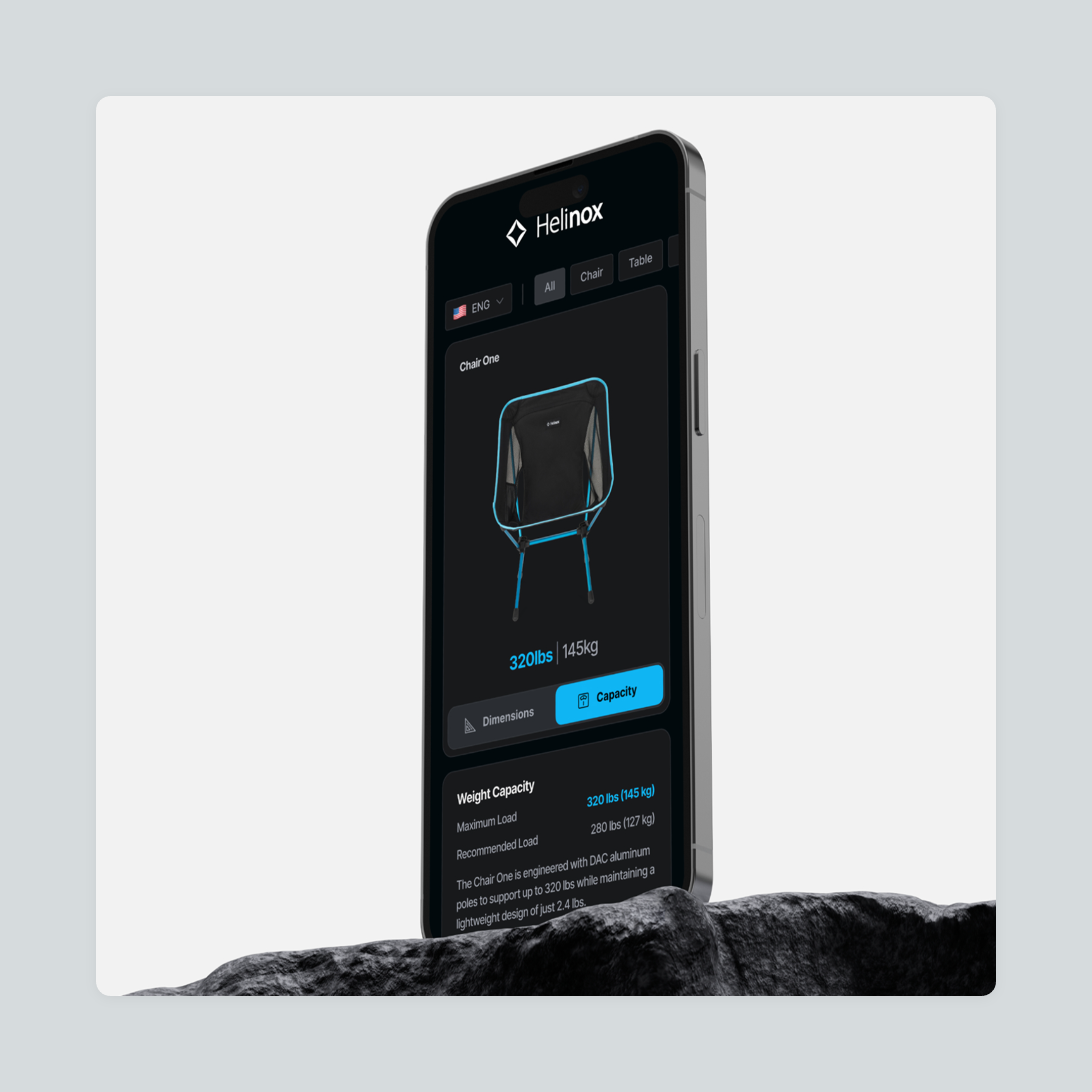
- Language dropdown for seamless switching across 8 languages.
- Navigation for quick sorting by product categories (e.g., Seating, Shelters, Accessories).
- Scrollable browse screen for all products.
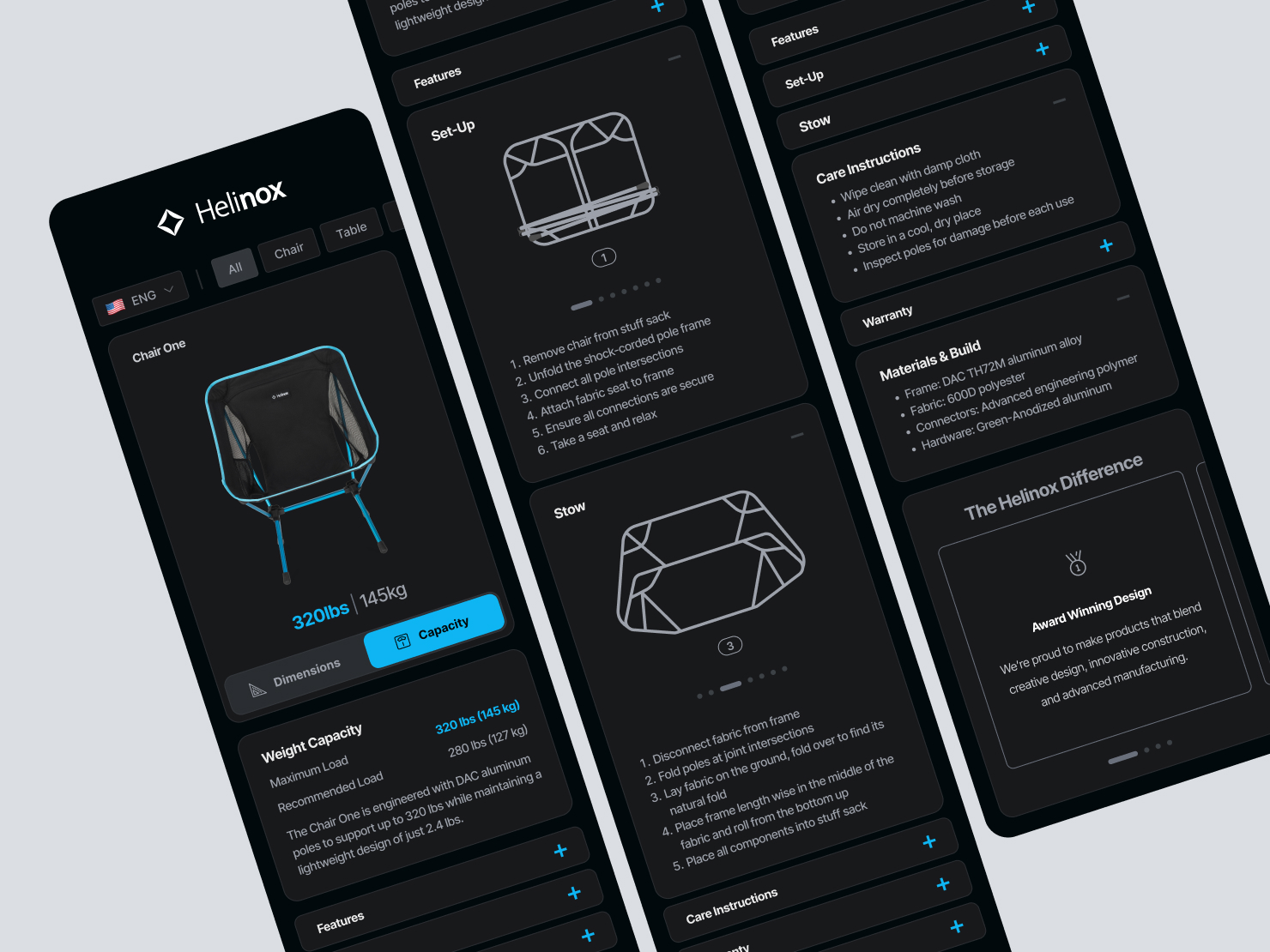
- Detail screens per product with dimensions, capacity, setup/disassembly instructions and illustrations, care tips, and warranty details.
This pivot aimed to reduce waste, empower users, and streamline retail interactions.
My Design Approach
I led the end-to-end design, focusing on intuitive UX, visual consistency, and multilingual scalability. Starting with user research (e.g., surveys of 50+ customers and retail staff), I identified core needs: fast loading on mobile (since QR scans are often in-store or outdoors), simple navigation to minimize frustration, and clear illustrations for non-readers.
Key Design Phases:
- Wireframing & Information Architecture: Mapped out the app structure—home screen with language selector and category nav; browse view as an infinite scroll grid; detail pages with tabbed sections (Dimensions, Setup, Care, Warranty). Ensured responsive design for phones/tablets.
- Branding Integration: Applied Helinox's visual identity—subtle gradients mimicking nature, iconography for quick scans (e.g., icons for weight/capacity), and high-contrast text for outdoor readability. Custom illustrations (e.g., step-by-step setup diagrams) were vector-based for scalability across languages.
- Multilingual UX: Designed the language dropdown as a prominent top-bar element with auto-detection fallback. Collaborated on localization to handle text expansion (e.g., German strings up to 30% longer) without breaking layouts.
- Prototyping & Testing: Built interactive Figma prototypes; iterated based on 3 rounds of usability testing (e.g., reduced clicks to product details from 4 to 2). Ensured accessibility (WCAG compliance: alt text for illustrations, voiceover support).
The result was a lightweight web-app—empowering users while reinforcing brand trust.
Results & Impact
Launched in 2024, the web-app delivered immediate wins, validated by analytics and feedback.
Key Metrics:
- Cost Savings: 60% reduction in printing costs by minimizing hangtag content (from multi-page multilingual booklets to a single QR-focused tag).
- User Empowerment: 75%+ of users (per GA4 data) accessed details without retail assistance, reducing staff queries by ~40% in pilot stores.
- Engagement: Average session time 2.5 minutes; 85% completion rate on setup instructions; Supported 8 languages with 95%+ translation accuracy.
- Sustainability: Eliminated ~50,000 printed pages annually (based on sales volume), aligning with Helinox's zero-waste goals.
- Business Uplift: Improved customer satisfaction (NPS +15 points in post-launch surveys); Potential for upsell integrations (e.g., linking to ecommerce for accessories).
Post-launch, the app became a model for other product lines, with plans for AR setup visualizations.